01 導讀:為什麼要建立學習系統
《如何高效學習:建立你的簡單有效學習系統,實現人生躍遷》 沙牛 北京聯合出版公司・真故圖書,2019年9月 ISBN 9787559633835
作者自序序言
大學之前,我的學習成績一直都不怎麼樣;工作之後從技術到產品經理到運營總監,作者說自己的專業課成績在系裏竟然獲得了第一名。他反覆強調的只有一件事:方法比知識重要。
「當時我就意識到:最重要的不是學習具體的知識,而是要掌握有效的學習方法。」
沙牛《如何高效學習》序言
全書三部分九章
第一部分(第一至二章)建立學習的系統:先有系統,才能談技能。
第二部分(第三至五章)學習的技術:閱讀、記筆記、管理學習成果。
第三部分(第六至九章)學習的技巧:覆盤、生物學原理、時間管理、工具。
「能夠提升我們專業技能的知識,一定不是孤立的、碎片化的學習能夠搞定的,而需要我們首先建立一個系統,再根據這個系統,運用正確的方式來學習。」
沙牛《如何高效學習》序言
02 核心模型:學習系統五步驟
書中「快速建立學習的系統」一章提出的五個步驟——這是全書的骨架,其餘八章都是對這五步的展開。
一、明確目標SMART
具體的、可以衡量的、可以達到的、相關性的、時限性。作者舉例:8個月學英語到年底能看懂英文網站、能用英語簡單交流。
「沒有明確的目標,人會容易放棄。」
第二章
二、通覽這個領域T 型結構
花一天搜關鍵詞、看前十頁文章,快速建立知識框架,並找出該領域的意見領袖與主流方法。
「通覽這個領域,除了找到對應的學習方法,還有一些其他的重要用途。」
第二章
三、制訂學習計劃目標分解
把最大目標分解成多個小目標,小目標同樣遵循 SMART。作者直接在目錄上寫 Day1、Day2。
「歸根結底,制訂學習計劃,就是把學習目標分解成多個小目標
第二章
四、開始學習系統 vs 碎片
有深度的技能要走讀書與微課;碎片化學習只能通覽與小技巧,絕不能指望靠閱讀知乎掌握一項重要技能。
「你永遠不能指望通過一個問答、一篇微信圖文就能夠學到系統化的技能
第二章
五、記錄、回顧、反思檢索練習+FSRS
回顧的正確打開方式是「合書回憶」:Roediger & Karpicke(2006)實驗中,一週後主動回憶組記住 61%,重讀四遍只記住 40%——學習時感覺流暢不代表學會了。長期排程交給演算法:FSRS 已內建於 Anki(23.10 起為官方演算法之一),以個人記憶曲線排程,同保留率下比舊演算法少 20–30% 複習量。
「反思不同於回顧,我們可以把它理解成更高層次的回顧。」
第二章
效率 vs 效果一字之差
效果是最終取得的成果,效率是在效果上加上時間的維度。時間有限,所以真正要管的是效率。
「效果和效率,一字之差,結果卻可能相差十萬八千里。」
第一章
03 互動:學習系統三要素流程圖
輸入 → 處理 → 輸出。點擊節點看該環節的做法與陷阱,流程會高亮當前環節。
04 工具:番茄鐘 + 目標倒推計劃器
第八章時間管理的原則:先搞定拖延症,再談技巧;技巧只要在目錄上寫上 Day1、Day2 那麼簡單就夠。
番茄鐘 · 25/5 專注循環
計時結束會在提示列顯示;本站不推送通知,請自己盯住計時。
休息時也不碰手機——注意力殘留(Leroy 2009):切換任務後注意力會殘留在前任務上數十分鐘,回消息 30 秒,代價是接下來十幾分鐘的學習品質。
目標倒推計劃器
輸入目標與期限,站內按天數算出每日投入與檢查點,並生成 SMART 小目標草稿。
間隔複習 · FSRS 排程器
輸入要記住的內容與考試/使用日期,站內用 FSRS 精神(間隔重複)排出「在將忘未忘的時刻複習」的檢查點——每次回憶成功,間隔就拉長。
進階做法:把每則重要筆記轉成「問題卡」用 Anki+FSRS(已內建於 Anki 23.10 起)管理,每天 10–15 分鐘清完當日排程;「記得/不記得」要誠實按,自欺只會讓演算法失效。同樣保留率下,FSRS 比傳統演算法少 20–30% 複習量。
05 自查:你的學習系統成熟度(18 題)
每題答「有」或「沒有」,計分後會給出對應的章節補強建議。小技巧(元認知校準):每題先猜自己「有/沒有」,再誠實作答——長期預測與實際落差,正是最好的學習導航儀。
06 速查:一頁看完學習系統
| 環節 | 做法(書中原文用詞) | 常見陷阱 |
|---|---|---|
| 目標 | SMART:具體、可衡量、可達成、相關、時限 | 「我要學英語」但沒有可衡量的驗收標準對應第二章 |
| 通覽 | 一天搜前十頁、建立知識框架、找出意見領袖 | 只下載工具軟件就當開始學了對應第二章 |
| 計劃 | 大目標拆小目標,目錄上寫 Day1/Day2 | 沒有計劃,空時翻兩頁,最後不了了之對應第二章、第八章 |
| 學習 | 讀書與微課為主;碎片化只在通覽時用 | 靠閱讀網頁掌握「有深度」的技能對應第二章 |
| 筆記 | 終極目標是再現性:事後能理清主線、找到結論 | 筆記雜亂不堪、沒有主題、沒有重點對應第四章 |
| 成果管理 | 這篇筆記「是什麼」定筆記本;「包含什麼」定標籤 | 要找的筆記散落在任何一本筆記本對應第五章 |
| 覆盤 | 陳列式 → 框架式 → 拓展式;本质是 PDCA;先「合書回憶」再對照查漏(檢索練習) | 只回顧不反思,等於機械重複對應第六章 |
| 生物學原理 | 髓磷脂與程序性技能相關;睡眠中記憶再鞏固;自控力「肌肉模型」證據薄弱——環境設計 > 意志力 | 注意力渙散下學複雜技能,迴路得不到隔離;熬夜學習是負收益對應第七章 |
| 時間管理 | 先搞定拖延症;用 if-then 執行意圖(「如果到了 Y,我就做 X」)+ 環境設計;動機 = 期望×價值÷(衝動×延遲) | 把拖延歸咎於意志力薄弱,然後什麼也沒改對應第八章 |
| 工具 | 文件管理、知識管理、時間管理、寫作、思維五類;卡片盒筆記(Zettelkasten)/PARA 是 2019 後新範式 | 沒有模板,重複勞動;桌面資料隨系統重裝消失對應第九章 |
| 鞏固 | 檢索 > 重讀;間隔重複交給 FSRS/Anki;睡前學習受益於睡眠鞏固 | 重看四遍產生「我會了」錯覺,一週後記憶不如只測驗一次的人 |
| 交錯學習 | 不同類型題目混合練習而非一類練完再練下一類;先整塊建立圖式,再用交錯打磨判斷力 | 第一遍理解新概念就用交錯,結果圖式都未建立 |
| 合意困難 | 讓當下更費力的學法往往更持久(合書回憶>重看、間隔>突擊、交錯>整塊) | 把「費力」誤解成材料超出能力——合意的是「能克服的費力」,過難只是挫敗 |
| 拖延 | if-then 執行意圖 + 環境設計(手機放遠處) | 把拖延歸咎於意志力薄弱,然後什麼也沒改 |
| AI 協同 | AI 出題你作答;先自答再對照;當陪練不當代筆 | 認知卸載:答案來得太容易,等大腦什麼也沒記住 |
07 章節精華:九章逐字金句
每章 2–3 條逐字摘自原書的原文金句,以及一句行動建議。點擊展開。
第一章 一般人的學習方式
「你有學習能力嗎 學習方法不僅是一門學問,更是一項值得花時間掌握的能力。」
沙牛《如何高效學習》
「其實,大多數的技能都需要長時間堅持學習,提升技能沒有一蹴而就的。」
沙牛《如何高效學習》
「你有正確的學習理念嗎 任何知識或技能,都有不同的學習方法,所以,在學習一項知識或技能之前,最重要的,是摸索出有針對性的學習方法。」
沙牛《如何高效學習》
行動建議:先建立學習系統再談努力
第二章 快速建立學習的系統
「雖然學習不同的知識和技能的方法是不一樣的,但是在具體技能之上我們卻可以找出其中通用的系統。」
沙牛《如何高效學習》
「個月的學習時間看起來很短,但是配合正確的學習方法,我能夠做到。」
沙牛《如何高效學習》
「通過通覽這個步驟,你找到了對應的學習方法,也明確了這個領域有哪些分支領域,所以現在你要做的,就是運用這個學習方法按順序逐一學習這些分支領域的知識。」
沙牛《如何高效學習》
行動建議:每次學習結束即做一次主動提取
第三章 如何通過閱讀進行學習
「要系統地學習一個領域的知識和技能,是絕對繞不開閱讀的。」
沙牛《如何高效學習》
「我一直認爲,如果我們想要系統地學習一項知識或技能,是絕對繞不開閱讀的,你可以不上微課,不參加線上線下的培訓,但是,如果不針對所學領域進行大量的閱讀,是絕對學不好的。」
沙牛《如何高效學習》
「之後,開始花大量時間來精讀這本書,在精讀的時候,我的方法簡單粗暴,就是使用一個A4紙大小的方格筆記本來製作大綱,這份大綱就是我的“大綱閱讀法”的關鍵。」
沙牛《如何高效學習》
行動建議:筆記只記「自己的話」而非抄寫
第四章 學習時如何記筆記
「因此,我們需要在學習過程中高度專注,但是一定要保證足夠的休息時間,因爲這是最好的消化知識的時機。」
沙牛《如何高效學習》
「所謂記錄場景,就是需要使用筆記本進行記錄的場合,比如,工作的時候、學習專業知識或技能的時候、記錄想法的時候、記錄待辦事項的時候等。」
沙牛《如何高效學習》
「康奈爾筆記法 康奈爾筆記法是美國大學生最常用的筆記方法,也是公認的最適合用於學習的筆記方法。」
沙牛《如何高效學習》
行動建議:每日覆盤 5 分鐘,記住教訓
第五章 管理學習成果
「比如,我建立了Pomonote這個公衆號,並通過分享番茄工作法、學習方法、筆記術和閱讀心得等影響了一些人,隨着我的長期堅持,這個影響圈越來越大,這就是在影響圈內做事的力量。」
沙牛《如何高效學習》
「而刻意對知識進行輸出,就是一個很好的方法,因爲在輸出的過程中,我們會無意識地對知識進行串聯和拓展。」
沙牛《如何高效學習》
「最後,堅持寫作輸出並刻意練習,你會一不小心就打造出一個不錯的個人品牌,我自己就是這樣過來的。」
沙牛《如何高效學習》
行動建議:把大目標切成可執行小步
第六章 覆盤
「而覆盤,其實就是對所學的新知識進行刻意練習。」
沙牛《如何高效學習》
「大部分人在學習一項新知識時吸收到的只是單一的知識點,而如果在學習後能對這些知識點進行復盤,那麼你就能夠把這些所學到的新知識串聯起來,讓它們連接成一條知識線。」
沙牛《如何高效學習》
「陳列式覆盤 陳列式覆盤是指在完成學習任務之後,有意識地進行回想,回想書中所有的知識點,想到一點,列出一點。」
沙牛《如何高效學習》
行動建議:固定學習時間,抵抗碎片
第七章 學習中的生物學原理
「要做到系統化地學習某一領域的知識,長時間保持專注力是前提。」
沙牛《如何高效學習》
「在專注時間段內,拒絕使用任何電子設備,專注時段最好設置在早上,你可以利用這段時間來學習最重要的內容,或者對重要的任務進行規劃和思考。」
沙牛《如何高效學習》
「專注力 在學習過程中,我們需要專注力,這是毋庸置疑的事實。」
沙牛《如何高效學習》
行動建議:先建立學習系統再談努力
第八章 學習過程中的時間管理
「因此,學習時間管理的正確方式,是先搞定拖延症,再來談具體的時間管理方法。」
沙牛《如何高效學習》
「雖然我現在時常給大家分享關於時間管理、學習方法和效率相關的內容,但你可能想不到,我以前完全是一個拖延症晚期患者。」
沙牛《如何高效學習》
「第八章 學習過程中的時間管理 第八章 學習過程中的時間管理 在學習過程中,能夠合理規劃並利用自己時間的能力,就是時間管理能力。」
沙牛《如何高效學習》
行動建議:每次學習結束即做一次主動提取
第九章 學習的工具
「在本章,我就爲大家詳細地介紹幾類工具,即文件管理工具、知識管理工具、時間管理工具、寫作工具和思維工具,並且附上我對這些工具的使用方法及心得。」
沙牛《如何高效學習》
「知識管理工具有哪些 我們在第五章裏已經介紹了以印象筆記爲中心的知識管理系統,其實,像印象筆記這樣的工具,我們還可以找到很多,比如同樣優秀的爲知筆記、有道雲筆記等。」
沙牛《如何高效學習》
「所謂資料庫,其實就是專注於某一類型的資料保存軟件,比如,印象筆記適合保存文檔、Pixave軟件適合保存圖片素材、Bear適合保存原創的寫作內容等。」
沙牛《如何高效學習》
行動建議:筆記只記「自己的話」而非抄寫
08 AI 時代的學習系統
編者導讀:原書寫於 2019 年,本章依照書中「工具化」精神,補充 AI 時代的學習協同——AI 不會取代學習者,但會取代「不會用 AI」與「只會用 AI」的學習者。
✅ AI 的三種正確用法陪練
① 出題器:讓 AI 根據你剛學的內容生成測驗題,你合書作答,再讓它批改講解——檢索練習的免費教練。
② 費曼聽眾:把你對某概念的講解發給 AI,請它扮演 12 歲小孩追問「為什麼」,直到你卡住——卡住處就是知識缺口。
③ 蘇格拉底陪練:「請不要直接給答案,用問題引導我自己推出來。」
⚠️ AI 的三種危險用法陷阱
① 認知卸載:讓 AI 直接給答案、寫總結、做翻譯——你得到結果,卻跳過了學習過程本身。大腦只鞏固它親自做過的提取。
② 能力錯覺:AI 生成的答案看起來都懂,合上對話框發現自己說不出來。檢驗標準永遠是:沒有 AI 在場,你能不能獨立完成?
③ 幻覺與偽權威:AI 會自信地出錯。凡重要知識,回到原始書籍與一手資料核實。
01 導讀:學會如何學習
《Learning How to Learn》 芭芭拉·奧克利(Barbara Oakley)& 泰倫斯·謝諾夫斯基(Terrence Sejnowski) Coursera 熱門課程.全球超過三百萬人修讀
導讀影片Opus 精華導讀
由 Opus 根據本書精髓製作的導讀影片:濃縮四週課程核心,從專注/發散模式到組塊、拖延與記憶宮殿,一次看懂。
導讀音訊開車/散步聽
把導讀影片的聲音獨立抽出來,方便通勤、散步時聽。配合下面的課程結構說明,一趟路程就能掌握全書地圖。
“Perhaps the greatest gift that our brains give us is the ability to learn new things every day.”
Oakley《Learning How to Learn》Introduction to the Course Structure
02 核心模型:四個學習開關
全課程的四塊基石——兩種思維模式、組塊、拖延與記憶、潛能開發。掌握了它們,等於掌握了「如何學習」的地圖。
一、專注/發散模式Focused & Diffuse
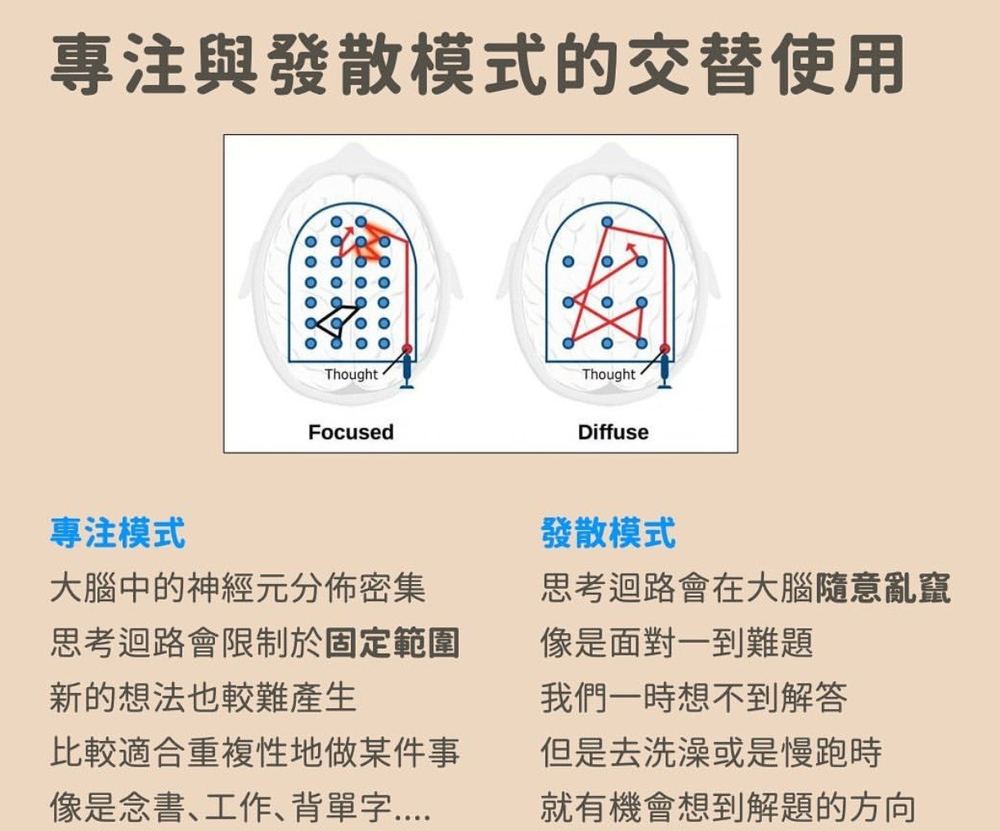
大腦有兩種思維模式:專注模式密集處理細節(彈珠機緊密擋板),發散模式放鬆接通全局(稀疏擋板)。交替使用、先專注後放鬆,是學習的根本節奏。
“You're either in the focused mode or the diffuse mode of thinking.”
Week 1
二、組塊Chunking
把零散知識打包成組塊(chunk),大腦才能輕鬆調用——像把 P-O-P 三個字母打包成 pop。組塊讓你理解、應用並組合出新創意。
“Focused practice and repetition, the creation of strong memory traces, helps you to create chunks.”
Week 2
三、拖延與記憶Procrastination & Memory
拖延是「不舒服 → 逃避 → 短暫愉悅」的殭屍習慣;對策是番茄工作法+過程導向。記憶則靠主動提取與間隔複習,加上睡眠的整理。
“Give yourself a little reward when you're done.”
Week 3
四、學習綻放Renaissance Learning
最後解放潛能:運動製造新生神經元、比喻與圖像強化理解、團隊討論互相補盲、別嫉妒天才——方法是練出來、不是天賦。
“The best gift that you can give your brain is physical exercise.”
Week 4
五、睡眠Sleep
睡眠時大腦會整理日間所學、強化重要連結並清除毒素。熬夜苦讀不如好好睡一覺——睡眠是學習的加速器,不是偷懶。
“You are not the same person you were after a night's sleep.”
Week 1
六、交錯練習Interleaving
重複同一種題型會陷入思維定勢;交錯練習不同類型題目,能迫使大腦在更高層次靈活判斷,是區分「學會」與「背熟」的關鍵。
“You can make your study time more valuable by interleaving, providing intelligent variety in your studies.”
Week 2
03 專注/發散模式:交替使用
大腦有兩種思維模式:專注(Focused)與發散(Diffuse)。兩者交替使用,學習最有效——專注理解細節,發散接通靈感。下圖一次過展示兩者在神經層面的分別。
04 工具:組塊檢索練習器 + 記憶宮殿生成器
主動提取比重讀有效:先閉書回想,再對照答案。下面兩件小工具幫你實踐課程裏的「檢索練習」與「記憶宮殿」。
組塊檢索練習
回想成功才代表真正掌握——如果一打開就看答案,那只是「幻覺的能力」(illusion of competence)。
記憶宮殿生成器
把每個詞想像成你熟悉地點(例如客廳、廚房、臥室)裏一個誇張、荒謬、有畫面的物品——越誇張越好記。
05 自查:你的「學會學習」指數(12 題)
每題答「是/否」,計分後會給出對應的課程章節建議。這 12 題正是課程反覆強調的高效學習行為。
06 速查:一頁看完學會學習
把課程四週最實用的方法壓縮成一頁,貼在書桌前。
| 情境 | 課程方法 | 一句口訣 |
|---|---|---|
| 學新概念卡住 | 專注模式卡住 → 起身散步/換件事,讓發散模式接手 | 卡住就放下 |
| 背誦大量內容 | 把內容打包成有意義的組塊、故事、圖像或記憶宮殿 | 打包成組塊 |
| 覺得「我懂了」 | 闔上書自己解一遍/講解給別人聽,能輸出才算懂 | 回想測試 |
| 不想開始 | 番茄鐘 25 分鐘+結束給自己小獎勵;專注於「過程」而非「產品」 | 25 分鐘衝浪 |
| 臨考前抱佛腳 | 提早開始、間隔複習、先做難題再跳簡單題(hard start) | 難→易→難 |
| 越練越卡 | 交錯練習不同類型題目,避免陷入思維定勢(Einstellung) | 換著練 |
| 睡眠不足 | 睡眠讓大腦整理記憶、強化連結——熬夜不如早睡 | 睡出記憶 |
| 害怕失敗 | 別嫉妒天才:方法是練出來的;運動能製造新的腦細胞 | 練出方法 |
07 章節精華:四週課程逐字金句
每課逐字摘自課程原文(英文)的金句,附一句中文導讀。點擊展開。
W1第一週|兩種思維模式
Introduction to the Focused and Diffuse Modes
大腦有專注與發散兩種思維模式:專注模式用於理解細節,發散模式用於打通全局;兩者交替使用,學習最有效。
“In this diffuse mode of thinking, you can look at things broadly from a very different, big picture perspective.”
Oakley & Sejnowski《Learning How to Learn》Course
“Now as far as neuroscientists know right now, you're either in the focused mode or the diffuse mode of thinking.”
Oakley & Sejnowski《Learning How to Learn》Course
“It turns out, though, that if you understand just a little bit of some of the basics about how your brain works, you can learn more easily and be less frustrated.”
Oakley & Sejnowski《Learning How to Learn》Course
Introduction to the Course Structure
課程目標是讓你更了解自己如何學習,並掌握「如何學」的實用方法——學到的不是知識本身,而是把任何知識學好的能力。
“And you'll learn to condense key ideas you're learning about, so you can grasp them more easily, master the simple, practical approaches outlined here, including simple tips to help prevent procrastination.”
Oakley & Sejnowski《Learning How to Learn》Course
“Instead, you're expected to take these ideas and apply them to whatever subject you're trying to learn or improve in, to help you learn more deeply, effectively, and with less frustration.”
Oakley & Sejnowski《Learning How to Learn》Course
“Perhaps the greatest gif that our brains give us is the ability to learn new things every day.”
Oakley & Sejnowski《Learning How to Learn》Course
Using the Focused and Diffuse Modes
從專注跳去發散再跳回來:放鬆時大腦仍默默運作,達利坐著讓鑰匙跌落驚醒、愛迪生手握鋼珠入睡,都是利用發散模式的經典做法。
“And as he would slip into his dreams, falling asleep, the key would fall from his hand and the clatter would wake him up, just in time so he could gather up those diffuse mode connections and ideas in his mind.”
Oakley & Sejnowski《Learning How to Learn》Course
“And off he'd go back into the focused mode bringing with him the new connections he'd made while in the diffuse mode.”
Oakley & Sejnowski《Learning How to Learn》Course
“Similarly, to build neuro-structure, you need to do a little work every day, gradually allowing yourself to grow a neuro-scaffold to hang your thinking on, a little bit every day and that's the trick.”
Oakley & Sejnowski《Learning How to Learn》Course
What is Learning?
學習依賴大腦繁複的神經網絡與無意識運作,睡眠與運動都在其中扮演關鍵角色;理解機制後,學習會更少挫折、更有效率。
“You will learn in this first week how to take advantage of your unconscious mind, and also sleep, to make it easier to learn new things and solve problems.”
Oakley & Sejnowski《Learning How to Learn》Course
“And we don't need to know how it's done in order to survive.”
Oakley & Sejnowski《Learning How to Learn》Course
“We are only aware of a very small fraction of all of the activity in the brain, so we need to rely on brain imaging techniques to guide us.”
Oakley & Sejnowski《Learning How to Learn》Course
A Procrastination Preview
拖延來自「先做不喜歡的事會啟動痛苦區」的反應;把注意力放到「過程」而非「產品」,再給完成後的小獎勵,是初步對策。
“Because if you're working on something, it means you're not working, on a lot of other things.”
Oakley & Sejnowski《Learning How to Learn》Course
“In this video, we're going to give you a little insight into procrastination.”
Oakley & Sejnowski《Learning How to Learn》Course
“When you look at something that you really rather not do, it seems that you activate the areas of your brain associated with pain.”
Oakley & Sejnowski《Learning How to Learn》Course
Practice Makes Permanent
芭芭拉從十歲怕數學到後來讀完工程博士:堅持每天做一點、扎實累積,神經連結會愈用愈強——練習造就永久。
“During this time of seeming relaxation, your brain's diffuse mode has a chance to work away in the background and help you out with your conceptual understanding.”
Oakley & Sejnowski《Learning How to Learn》Course
“This helps you get going, using brief periods each day of focused attention that will help you start building the neural patterns you need to be more successful in learning more challenging materials.”
Oakley & Sejnowski《Learning How to Learn》Course
“If you have problems with procrastination, that's when you want to use the Pomodoro, that brief timer.”
Oakley & Sejnowski《Learning How to Learn》Course
Introduction to Memory
記憶分工作記憶與長期記憶:工作記憶像小小的黑板只有四個槽位,長期記憶像大倉庫需要反覆提取才能穩固。
“Research has shown when you first try to put a short term memory in long term memory, you need to revisit it at least a few times to increase the chances that you'll be able to find later when you might need it.”
Oakley & Sejnowski《Learning How to Learn》Course
“But what I'm trying to hold a few ideas in mind to connect them together so I can understand a concept or solve a problem, I'm using my working memory.”
Oakley & Sejnowski《Learning How to Learn》Course
“Your working memory is centered out of the prefrontal cortex, although as we'll see later, there are also connections to other parts of your brain, so you can access long term memories.”
Oakley & Sejnowski《Learning How to Learn》Course
The Importance of Sleep in Learning
睡眠是學習不可或缺的一部分:入睡前大腦會整理白天所學、清除毒素、強化重要連結;熬夜學習往往得不償失。
“Sleep has also been shown to make a remarkable difference in your ability to figure out difficult problems and to understand what you're trying to learn.”
Oakley & Sejnowski《Learning How to Learn》Course
“Of course, you must also plant the seed for your diffuse mode by first doing focused mode work.”
Oakley & Sejnowski《Learning How to Learn》Course
“Taking a test without getting enough sleep means you're operating with a brain that's got little metabolic toxins floating around in it.”
Oakley & Sejnowski《Learning How to Learn》Course
Summary Video for Module 1
第一週重點:專注與發散模式互補、練習造就永久、善用睡眠與無意識——學習不是苦幹,而是用對方法。
“You want to avoid taking tests or doing anything difficult with little sleep the night before, because it's like trying to think with poison on the brain.”
Oakley & Sejnowski《Learning How to Learn》Course
“The easiest way to tackle procrastination is to use the Pomodoro technique; that brief 25 minute stretch of focused concentration, followed by a bit of mental relaxation.”
Oakley & Sejnowski《Learning How to Learn》Course
“If you practiced and repeated something well enough to get it into long term memory, you can usually call it up later if you need it, although you may need an occasional bit of repetition to freshen the memory up.”
Oakley & Sejnowski《Learning How to Learn》Course
W2第二週|組塊 Chunking
Introduction to Chunking
組塊是讓大腦輕鬆調用的壓縮資訊包;把零散知識「打包」,理解與創造才會發生。
“We'll talk about how you can form chunks, how you can use them to improve your understanding of, and creativity with the material, and how chunks can help you do better on tests.”
Oakley & Sejnowski《Learning How to Learn》Course
“We'll cover what those less effective study methods are and tell you what methods research has shown will work better to help you in your studies.”
Oakley & Sejnowski《Learning How to Learn》Course
“You can make your study time more valuable by interleaving, providing intelligent variety in your studies.”
Oakley & Sejnowski《Learning How to Learn》Course
What is a Chunk?
組塊是透過專注練習與重複形成的強記憶線索,例如把 P-O-P 三個字母打包成「pop」;活用組塊是高效學習的核心。
“Focused practice and repetition, the creation of strong memory traces, helps you to create chunks.”
Oakley & Sejnowski《Learning How to Learn》Course
“The new logical whole makes the chunk easier to remember, and also makes it easier to fit the chunk into the larger picture of what you're learning.”
Oakley & Sejnowski《Learning How to Learn》Course
“The octopus of attention that slips its tentacles through those four slots of working memory when necessary to help you make connections to information that you might have in various parts of your brain.”
Oakley & Sejnowski《Learning How to Learn》Course
How to Form a Chunk - Part 1
形成組塊三步:全程專注、理解基本概念、練習並應用背景脈絡;一次專注只做好一個組塊。
“How to form a Chunk – Part 1 In this video, we're going to give you a little background about how to make a chunk.”
Oakley & Sejnowski《Learning How to Learn》Course
“Later you can hit those larger chunks into still larger and more complex chunks that you can draw up in an instant, in reaction to say to a slight, shift and twist in a soccer ball that's coming your way.”
Oakley & Sejnowski《Learning How to Learn》Course
“The best chunks are the ones that are so well ingrained, that you don't even have to consciously think about connecting the neural pattern together.”
Oakley & Sejnowski《Learning How to Learn》Course
How to Form a Chunk - Part 2
組塊要融入情境:上層組塊(大概念)與下層組塊(步驟)都要會,並透過「在做中學」讓組塊真正為你所用。
“Context means going beyond the initial problem and seeing more broadly, repeating and practicing with both related and unrelated problems, so that you can see not only when to use the chunk, but when not to use it.”
Oakley & Sejnowski《Learning How to Learn》Course
“Or at least they can grasp those ideas if they allow the focused and diffuse modes of thinking to take turns in helping them figure out what's going on.”
Oakley & Sejnowski《Learning How to Learn》Course
“There's a bottom up chunking process, where practice and repetition can help you both build and strengthen each chunk, so you can easily access it whenever you need to.”
Oakley & Sejnowski《Learning How to Learn》Course
Illusions of Competence
只看解答會造成「我懂了」的錯覺——闔上書自己能解、能講解,才是真正的精通;回想測試是破除錯覺的利器。
“Because they allow you to make repairs and you're thinking flaws bit by bit mistakes help correct your thinking, so that you can learn better and do better.”
Oakley & Sejnowski《Learning How to Learn》Course
“You want to try not to repeat you mistakes, of course, but mistakes are very valuable to make in your little self-tests before high stakes real tests.”
Oakley & Sejnowski《Learning How to Learn》Course
“A super helpful way to make sure you're learning and not fooling yourself with illusions of competence, is to test yourself on whatever you're learning.”
Oakley & Sejnowski《Learning How to Learn》Course
What Motivates You?
動機來自內在價值與對未來的想像:明確的目標、學習社群、對大腦的了解都能提供持續動力。
“This can motivate you to do something that may not be rewarding right now but will lead to a much better reward in the future.”
Oakley & Sejnowski《Learning How to Learn》Course
“Acetylcholine neurons form neuromodulatory connections to the cortex that are particularly important for focused learning, when you are paying close attention.”
Oakley & Sejnowski《Learning How to Learn》Course
“Serotonin is a third diffuse neuromodulatory system that strongly affects your social life.”
Oakley & Sejnowski《Learning How to Learn》Course
The Value of a Library of Chunks
在腦中建立組塊圖書館:多種技能與概念的組塊愈多,面對新問題時能組合的創意就愈豐富。
“When you're trying to figure something out, if you have a good library of these chunks, you can more easily skip to the right solution by metaphorically speaking, listening to whispers from your diffuse mode.”
Oakley & Sejnowski《Learning How to Learn》Course
“Keep in mind that the diffuse mode's semi-random way of making connections means that the solutions they provide should be very carefully verified using the focused mode.”
Oakley & Sejnowski《Learning How to Learn》Course
“But if you don't practice with your growing chunks, they can remain faint, and it's harder to put together the big picture of what you're trying to learn.”
Oakley & Sejnowski《Learning How to Learn》Course
Overlearning, Choking, Einstellung, and Interleaving
重複練習固然重要,但過度練習會陷入思維定勢(Einstellung);交錯練習不同類型的題目,能打破模式並深化理解。
“This kind of wrong approach is especially easy to do in sports and science, not to mention other disciplines, because sometimes your initial intuition about what's happening or what you need to be doing is misleading.”
Oakley & Sejnowski《Learning How to Learn》Course
“The reality is, once you've got the basic idea down during a session, continuing to hammer away at it during the same session doesn't strengthen the kinds of long term memory connections you want to have strengthened.”
Oakley & Sejnowski《Learning How to Learn》Course
“Mastering a new subject means learning not only the basic chunks, but also learning how to select and use different chunks.”
Oakley & Sejnowski《Learning How to Learn》Course
Summary Week 2
第二週重點:組塊的形成方法、破除「好像懂了」的錯覺、建立組塊圖書館、用交錯練習避免思維僵化。
“Try to avoid depending too much on highlighting, which can fool you into thinking that the material is going into your brain when it actually isn't. • Mistakes are a good thing to make when you're learning.”
Oakley & Sejnowski《Learning How to Learn》Course
“You can think of a chunk as a scintillating network of neurons that compactly synthesizes key ideas or actions. • Chunks can get bigger and more complex.”
Oakley & Sejnowski《Learning How to Learn》Course
“Also try recalling material in places that are different from where you originally learned the material, so it becomes more deeply ingrained and accessible, regardless of what room you're in.”
Oakley & Sejnowski《Learning How to Learn》Course
W3第三週|拖延與記憶
Introduction to Procrastination and Memory
拖延與記憶是學習的兩大敵人與盟友:拖延要理解、記憶要主動提取——這週教你馴服兩者。
“Because building solid chunks of long term memory, chunks that are easily accessible by your short term memory, takes time.”
Oakley & Sejnowski《Learning How to Learn》Course
“Ways that don't take much will power, then we'll move on to talking about some of the best ways to access your brain's most powerful long-term memory systems.”
Oakley & Sejnowski《Learning How to Learn》Course
“It's not the kind of thing you want to be putting off until the last minute.”
Oakley & Sejnowski《Learning How to Learn》Course
Tackling Procrastination
拖延的根源是對厭惡任務的逃避;番茄工作法(25 分鐘專注+獎勵)能避開痛苦開機,讓你用過程而不是產品來思考。
“Even if you're pretty good already in handling procrastination you'll learn some helpful insights here that can allow you to better prioritize your learning.”
Oakley & Sejnowski《Learning How to Learn》Course
“As you'll see you can trick some of these zombies into helping you fend off procrastination when you need to.”
Oakley & Sejnowski《Learning How to Learn》Course
“You can choke on tests because you haven't laid the firm neural foundations you need to feel comfortable with the material.”
Oakley & Sejnowski《Learning How to Learn》Course
Zombies Everywhere
我們常被「殭屍模式」(無意識習慣反應)控制:拉開門把就鎖門、坐下就滑手機。覺察自己的殭屍習慣,是改變的第一步。
“But, once you've chunked how to back up down your driveway, all you have to do is think, let's go.”
Oakley & Sejnowski《Learning How to Learn》Course
“That's the point of habit, you don't have to think in a focused manner about what you’re doing while you're performing the habit.”
Oakley & Sejnowski《Learning How to Learn》Course
“Procrastination's an easy habit to develop because the reward, moving your mind's focus to something more pleasant, happens so quickly and easily.”
Oakley & Sejnowski《Learning How to Learn》Course
Surf's Up: Process versus Product
專注在「過程」而非「產品」:把注意力放在接下來的幾分鐘,而非「必須完成整份作業」——衝浪要能上浪才有機會到岸。
“If you find yourself avoiding certain tasks because they make you feel uncomfortable, you should know there's another helpful way to re-frame things.”
Oakley & Sejnowski《Learning How to Learn》Course
“Instead, you need to focus on the process or processes – the small chunks of time you need over days or even weeks to answer the questions or prepare for tests.”
Oakley & Sejnowski《Learning How to Learn》Course
“For you, one of the easiest ways to focus on process is to focus on doing a Pomodoro, a 25 minute timed work session, not on completing a task.”
Oakley & Sejnowski《Learning How to Learn》Course
Harnessing Your Zombies to Help You
利用習慣的力量:設定固定時間地點學習、建立啟動程序,讓「殭屍」自動幫你開機,而不是拖你下水。
“The most important part of changing your procrastination habit is the belief that you can do it.”
Oakley & Sejnowski《Learning How to Learn》Course
“You don't want to do a full scale change of old habits.”
Oakley & Sejnowski《Learning How to Learn》Course
“To understand that, it helps to go back through the four components of habit and re-analyze them from the perspective of procrastination.”
Oakley & Sejnowski《Learning How to Learn》Course
Juggling Life and Learning
生活與學習要兼顧:給重要事情設定期限、建立待辦清單、學會說「不」,避免工作記憶被雜務塞滿。
“Then each day on another page of your planner journal, write a list of the tasks that you can reasonably work on or accomplish.”
Oakley & Sejnowski《Learning How to Learn》Course
“Research has shown that this helps your subconscious to grapple with the tasks on the list so you can figure out how to accomplish them.”
Oakley & Sejnowski《Learning How to Learn》Course
“If you don't write your tasks down on a list, they lurk at the edge of the four or so slots of your working memory, taking up valuable mental real estate.”
Oakley & Sejnowski《Learning How to Learn》Course
Summing Up Procrastination
拖延總結:用習慣、獎勵與過程導向對抗它;記住——你的感覺會騙你,開始行動後痛苦通常會消失。
“Try putting yourself in new surroundings with few procrastination cues, such as the quiet section of a library. Gain trust in your new system.”
Oakley & Sejnowski《Learning How to Learn》Course
“This is why tackling procrastination is so incredibly important.”
Oakley & Sejnowski《Learning How to Learn》Course
“You want to keep up with your learning and avoid last minute cramming.”
Oakley & Sejnowski《Learning How to Learn》Course
Diving Deeper into Memory
長期記憶靠反覆提取來穩固:回想比重讀有效(測試效應),間隔複習比臨時抱佛腳持久。
“To begin tapping into your visual memory system try making a very memorable visual image representing one key item you want to remember.”
Oakley & Sejnowski《Learning How to Learn》Course
“The more neural hooks you can build by evoking the senses, the easier it will be for you to recall the concept and what it means.”
Oakley & Sejnowski《Learning How to Learn》Course
“The more you can turn what you're trying to remember into something memorable, the easier it will be to recall.”
Oakley & Sejnowski《Learning How to Learn》Course
What is Long Term Memory?
長期記憶如倉庫:存入需要練習,提取需要線索;安眠能讓重要連結事半功倍。
“Curiously, you could have a normal conversation with HM, but if you left the room for a few minutes, he could not remember you or what you had discussed.”
Oakley & Sejnowski《Learning How to Learn》Course
“From the studying HM and animals with similar operations, we have learned that the hippocampus is important part of a brain system for learning and memory of facts and events.”
Oakley & Sejnowski《Learning How to Learn》Course
“Without the hippocampus and its inputs, it is not possible to store new memories in the cortex, a process called memory consolidation that can take many years.”
Oakley & Sejnowski《Learning How to Learn》Course
Creating Meaningful Groups and the Memory Palace Technique
把要記的內容變成有意義的故事、諧音、圖像或「記憶宮殿」,能大幅提升提取效率;有系統的想像力是最好的記憶工具。
“Like the layout of your house, and using it as a sort of a visual notepad where you can deposit the concept images that you want to remember.”
Oakley & Sejnowski《Learning How to Learn》Course
“The first letters abbreviate to GRHM, so all you need to do to remember is use the image of a graham cracker.”
Oakley & Sejnowski《Learning How to Learn》Course
“The memory palace technique is a particularly powerful way of grouping things you want to remember.”
Oakley & Sejnowski《Learning How to Learn》Course
Summing Up Memory
記憶總結:組合與縮寫、反覆提取、間隔練習、配上美好睡眠——用心又用方法,記憶力人人可練。
“By making meaningful groups and abbreviations, you can simplify and chunk what you're trying to learn so you can more easily store it in memory.”
Oakley & Sejnowski《Learning How to Learn》Course
“You need to practice and repeat in order to help store items in long term memory so you can retrieve them more easily.”
Oakley & Sejnowski《Learning How to Learn》Course
“It helps you build better memories because you start earlier. The second, is working memory, which is like a poor blackboard that quickly fades.”
Oakley & Sejnowski《Learning How to Learn》Course
W4第四週|學習綻放與潛能開發
How to Become a Better Learner
成為更好的學習者:多運動(增加海馬迴新生神經元)、多練習、多回想、多睡;伸展你的思考能力極限。
“These new neurons help you learn new things but they will die if you don't use them.”
Oakley & Sejnowski《Learning How to Learn》Course
“Tip number one – the best gift that you can give your brain is Physical Exercise.”
Oakley & Sejnowski《Learning How to Learn》Course
“One of these places is in your Hippocampus, a brain area that is very important for learning new things that we already discussed earlier in the course.”
Oakley & Sejnowski《Learning How to Learn》Course
Introduction to Renaissance Learning and Unlocking Your Potential
最後一週:像文藝復興人一樣學習——連結不同領域、擁抱數理與人文、將潛能徹底開發。
“One important thought though, before we launch into this week's videos, learning doesn't progress logically, so that each day just adds an additional neat package to your knowledge shelf.”
Oakley & Sejnowski《Learning How to Learn》Course
“In the case of language learners, they experience occasional periods when the foreign language suddenly seems completely incomprehensible.”
Oakley & Sejnowski《Learning How to Learn》Course
“This is a natural phenomenon, that means that your mind is wrestling deeply with the material.”
Oakley & Sejnowski《Learning How to Learn》Course
Create a Lively Visual Metaphor or Analogy
為抽象概念創造生動的比喻或類比:圖像與故事能讓大腦更易抓住並輸出知識。
“Metaphors and visualization, being able to see something in your mind's eye, have been especially helpful not only in art and literature, but also in allowing the scientific and engineering world to make progress.”
Oakley & Sejnowski《Learning How to Learn》Course
“Metaphors and models are often vitally important in giving a physical understanding of the central idea behind the process or concept you are trying to understand.”
Oakley & Sejnowski《Learning How to Learn》Course
“Stories, even if they're just used as silly memory tricks, can also allow you to more easily retain what you're trying to learn.”
Oakley & Sejnowski《Learning How to Learn》Course
No Need for Genius Envy
別羡慕天才:大多數成功源於正確方法與持續努力;你不是缺乏天賦,而是尚未用對學習策略。
“Smooth repetition creates muscle memory, so your body knows what to do from a single thought, one chunk, instead of having to recall all the complex steps involved in hitting a ball.”
Oakley & Sejnowski《Learning How to Learn》Course
“Your hot rod of a memory may be able to hold nine things in mind instead of four and you can latch on to those things like a bulldog, which makes it easier to learn.”
Oakley & Sejnowski《Learning How to Learn》Course
“It's not necessary to go around with a hundred beans in your pocket and to lay out ten rows of ten beans again and again so you get that ten times ten is equal to 100.”
Oakley & Sejnowski《Learning How to Learn》Course
Change Your Thoughts, Change Your Life
改變想法就能改變行為與人生:用積極的自我對話、運動放鬆與正面想像,重塑你的學習與生活。
“When you use neural circuits however, it seems you help build the myelin sheath over them; not to mention making many other microscopic changes.”
Oakley & Sejnowski《Learning How to Learn》Course
“One of the most unusual people I've ever read about, is inspiring not only because he was so extraordinary, but also, because he was so ordinary.”
Oakley & Sejnowski《Learning How to Learn》Course
“There's evidence that myelin sheaths, the fatty insulation that helps signals move more quickly along a neuron, don't finish developing in some people until they're in their twenties.”
Oakley & Sejnowski《Learning How to Learn》Course
The Value of Teamwork
團隊合作威力無窮:與他人討論能釐清思路、互補盲點,就像費曼所說——解釋給別人聽,是最佳的學習方式。
“We also don't want to throw the baby out with the bath water, and ignore worthwhile research that gives intriguing hints about differences between the two hemispheres of the brain.”
Oakley & Sejnowski《Learning How to Learn》Course
“In some sense, when you whiz through a homework or test question and don't go back to check your work, you're acting a little like a person who's refusing to use parts of your brain.”
Oakley & Sejnowski《Learning How to Learn》Course
“But these non-sensical results just don't matter to you because the more left centered focus mode has associated with it a desire to cling to what you've done.”
Oakley & Sejnowski《Learning How to Learn》Course
A Test Checklist
考試前檢查清單:充足的睡眠、提早開始複習、先做難題再跳簡單題、保持冷靜——考試本身也是學習的一部分。
“Virtually everything we've talked about in this course has been designed to help make the testing process seem straightforward and natural, simply an extension of the normal procedures you use to learn the material.”
Oakley & Sejnowski《Learning How to Learn》Course
“This means that the effort you put into test-taking, including the preliminary mini test of your recall and your ability to problem solve during your preparation is of fundamental importance.”
Oakley & Sejnowski《Learning How to Learn》Course
“So it's time now to cut directly to one of the final features of this course: a checklist you can use to see whether your preparation for test taking is on target.”
Oakley & Sejnowski《Learning How to Learn》Course
Hard Start - Jump to Easy
考試策略:先硬著頭皮看難題激活發散思維,再跳去容易題建立信心,最後回頭完成難題——難易交錯能發揮最佳表現。
“But to access the diffuse mode, you need to not be focusing on what you so badly want to solve.”
Oakley & Sejnowski《Learning How to Learn》Course
“You may not be able to get all the way to the end immediately, but at least you can get further before you switch to something else of which you can make progress.”
Oakley & Sejnowski《Learning How to Learn》Course
“The hard start jump to easy technique may make more efficient use of your brain by allowing different parts of the brain to work simultaneously on different thoughts.”
Oakley & Sejnowski《Learning How to Learn》Course
Final Helpful Hints for Tests
考試最後提醒:心態放鬆、專注當下、檢查粗心錯誤;緊張時深呼吸,提醒自己準備充分。
“This means whenever possible, you should blink, shift your attention, and then double check your answers using a, a big picture prospective asking yourself, does this really makes sense.”
Oakley & Sejnowski《Learning How to Learn》Course
“When you're checking your work if you start more towards the back and work towards the front, it sometimes seems to give your brain a fresher perspective that can allow you to more easily catch errors.”
Oakley & Sejnowski《Learning How to Learn》Course
“Susan Sajna-Hebert, a professor of psychology at Lakehead University, advises her students to cover up the answers to multiple choice questions and to try to recall the information.”
Oakley & Sejnowski《Learning How to Learn》Course
Summary
四週總結:專注+發散雙模式、組塊與交錯練習、馴服拖延、善用記憶宮殿、運動睡眠——把方法變成習慣,人人都能學會「如何學習」。
“Approaches such as switching your mode of thinking from focused to diffuse can help reduce your frustration and allow for more creative problem solving.”
Oakley & Sejnowski《Learning How to Learn》Course
“But now that you have a better feeling for what's under your neural hood, you can use this to help you learn new things all during your lifetime.”
Oakley & Sejnowski《Learning How to Learn》Course
“One of the best things you can do to not only remember, but more easily understand concepts in many different fields, is to create a metaphor or analogy for them.”
Oakley & Sejnowski《Learning How to Learn》Course